

Floppy says: Coat colors are interesting, but health deserves the spotlight. My owner will explain the names without turning them into a breeding recipe.
The owner’s explanation
Dachshunds have three coat varieties: smooth, longhaired, and wirehaired. Color describes the pigment, while pattern describes how that pigment is distributed. These are separate traits, so a dog can be longhaired, black and tan, and dapple at the same time.
For owners, the useful questions are how to care for the coat and what health information to request. An unusual color is not a health certificate, and appearance alone cannot establish a dog's ancestry or breeding suitability.

The three coat types
Smooth
The short coat is relatively straightforward to brush and inspect. Short hair still sheds, and a smooth-coated dog still needs skin checks, nail care, and ordinary grooming. “Shorthaired” does not mean maintenance-free.
Longhaired
Longer hair and feathering need regular attention, especially behind the ears, under the body, and around the legs. Check for tangles before they tighten into mats. A groomer can demonstrate a routine that suits the individual coat.
Wirehaired
The harsh outer coat and softer undercoat need a different approach from a smooth coat. Ask a groomer familiar with wirehaired dogs about coat maintenance, including whether hand-stripping or clipping is appropriate for your goals and the dog's comfort. Do not pull hair simply because the coat looks untidy.
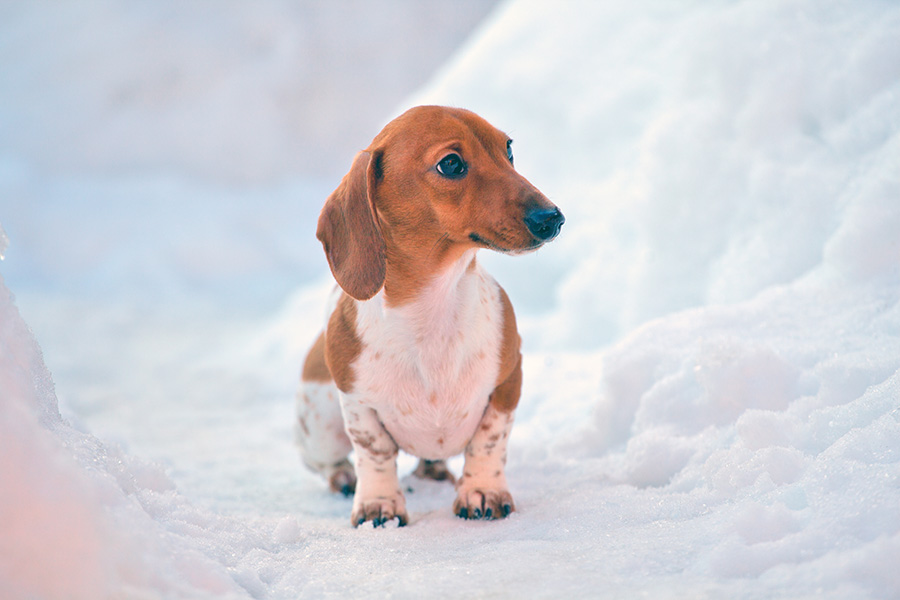
Base colors and markings
Common descriptions include red, cream, black and tan, and chocolate and tan. Wild boar is another color description associated with the breed. Blue and isabella refer to dilute pigmentation. Color names can be used inconsistently in advertising, so ask what the seller means rather than relying on a dramatic label.
The AKC standard is the appropriate reference for U.S. show descriptions. It is not a diagnostic guide, and standards used by other registries may differ. A pet does not need show-perfect markings to be a valued companion.

Patterns are not interchangeable
- Dapple refers to merle-patterned areas of diluted pigment.
- Brindle describes darker striping; it is not another name for dapple.
- Piebald describes white spotting and is not automatically double dapple.
- Sable describes a pattern involving darker-tipped hairs; casual visual identification can be unreliable.
A blue eye or a white patch does not, by itself, tell you a dog's complete genotype. Photographs, especially of puppies whose coats later change, are not enough for responsible breeding decisions.

Why dapple-to-dapple breeding is a concern
UC Davis explains that breeding dogs carrying merle variants can produce double-merle offspring with an increased risk of serious defects, including hearing and eye problems. Some merle variants can be difficult to recognize visually. Do not use a seemingly solid-colored coat as proof that a dog does not carry merle. See UC Davis Veterinary Genetics Laboratory: merle.
The responsible next step is veterinary and genetic guidance, not an online color-pairing recipe. This article does not recommend breeding two dapple dogs. Genetics is more complicated than a simple chart in which every color has one dominant or recessive gene.

Health is more important than a rare-color label
Some dilute-coated dogs can develop coat problems, but color alone does not diagnose illness or predict how an individual dog will fare. Hair loss, itching, redness, or recurrent skin trouble needs a veterinary assessment.
Likewise, a double-dapple dog already in rescue should not be rejected as unworthy of adoption. Ask about hearing and vision assessments, daily care needs, and suitable home adaptations. The concern is avoiding preventable harm in breeding, not devaluing dogs with disabilities.
Questions to ask before choosing a puppy
Ask for the parents' identities, relevant health-screening records, a veterinary care history, and an explanation of any genetic testing. Request actual records rather than accepting “vet checked” or “rare” as substitutes. Ask how the breeder matches puppies to homes and supports owners if a problem develops.
Choose for health information, temperament, and the care you can provide. A striking coat may catch your eye, but those practical details matter much more over a dog's lifetime.
Related guides
- A Guide To Coat Varieties In Dachshund
- Are Dapple Dachshunds Purebred?
- Dog Skin Allergies: Causes, Symptoms, and Treatments