
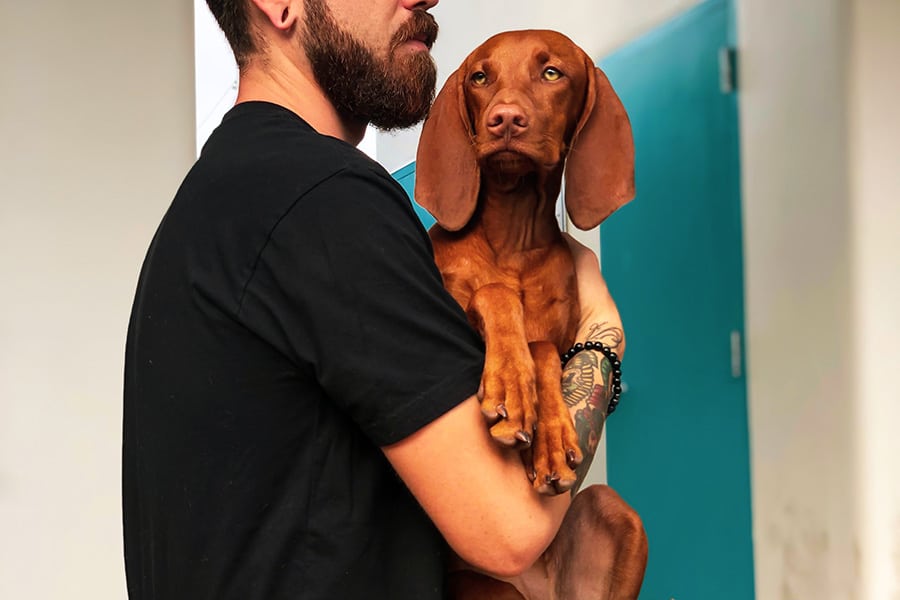
Floppy says: Clear lessons and a kind human make a good team. A snack-sized reward is welcome too!
From Floppy’s owner: A good dachshund routine combines clear teaching, appropriate activity, careful handling, and attention to changes in health. You do not need to be a “pack leader” or overpower a small dog. Make useful behaviors easy to practice and get help when a problem is painful, frightening, or unsafe.
Make household rules clear

Decide where the dog sleeps, how meals are managed, and who provides walks and toilet breaks. Use the same cues and reward the same behaviors across the household. A dog cannot reliably follow a rule that changes from one person to another.
Teach a useful alternative instead of relying on “no”: settle on a mat during dinner, exchange a toy, or come away from the window. Practice in a quiet setting before expecting the skill during excitement.

Do not punish toilet accidents
Offer frequent, predictable opportunities and reward toileting in the right place. Supervise until the dog is reliable and clean accidents appropriately. Sudden accidents in a previously reliable dog deserve a health check rather than an assumption of defiance.

Keep chewable belongings out of reach and offer suitable supervised alternatives. If the dog repeatedly destroys objects during absences, assess distress rather than simply buying tougher furniture.
Handle the body with support
When lifting, support the front of the body and hindquarters, keeping the dog secure. Do not lift by the paws or allow the rear end to dangle. Plan safe access around furniture and stairs, especially for puppies or dogs with a medical condition.
Dachshunds have an important predisposition to disc disease, but it is inaccurate to claim that ordinary stairs inevitably cause it or that one handling rule prevents it. Ask your veterinarian for an individual activity plan. Pain needs prompt veterinary advice. Sudden weakness, wobbliness, or trouble standing or walking needs urgent veterinary assessment.
Give activity and rest equal attention
Offer walks, sniffing, appropriate games, and chances to relax. A dog that is always stimulated may need help settling, while one with little interaction may need more enrichment. Adjust to age, fitness, weather, and health rather than following a single exercise number.
Do not rely on recall around wildlife until it is well practiced, and even then manage risk with secure spaces and suitable leash use.
Keep weight and grooming on the agenda
Measure food consistently and account for treats. Ask your vet about body condition rather than trying to keep a dog within a size label. Check the coat, skin, nails, ears, and mouth routinely, and use grooming sessions to notice changes without forcing painful handling.
Do not use coat type alone to predict an individual dog’s temperament. A quiet longhaired dog and an outgoing wirehaired dog are individuals, not proof of a universal rule.
Respect warnings and boundaries
Give dogs space around meals, chews, and sleep. Growling is a reason to stop and assess the situation, not a cue to prove authority. Keep children out of behavior experiments and seek qualified help for guarding, biting, or persistent distress.
A practical next step is to choose one recurring difficulty and keep a short record of when it happens. That makes training more focused and gives your veterinarian or trainer better information if you need support.