
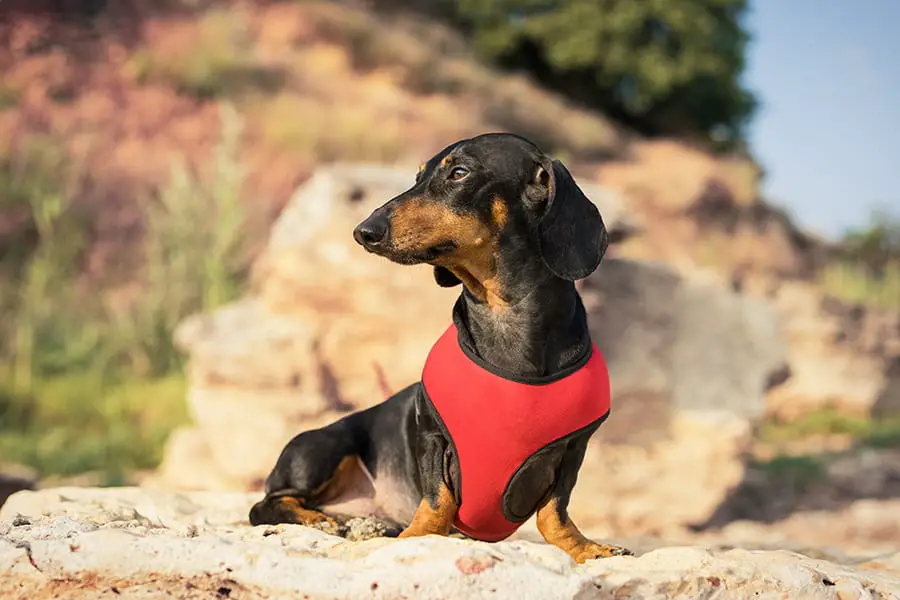
Floppy says: Sniffing adventures are on my agenda. A comfy harness, please!
From Floppy’s owner: The best harness for a dachshund is one that fits that particular dog's chest and neck, stays in place, and allows comfortable movement. Choose by measurements and a supervised fit test, not by a breed label or an online ranking. A walking harness is not a back brace, and it has not been established that wearing one prevents intervertebral disc disease (IVDD).
A dachshund's deep chest and short legs can make off-the-shelf sizing tricky. Two dogs with the same weight may need different sizes, and a harness that looks comfortable while standing can rub behind the front legs during a walk.

Measure before comparing brands
Use a flexible tape to measure the chest at the location shown in the manufacturer's sizing diagram, usually around its widest part. Measure the neck where the harness will sit, not automatically where a collar sits. Record the measurements and compare them with the chart for the exact model, not another harness from the same company.
If your dog falls between sizes, ask the manufacturer about the adjustment range and return policy. Sizing up without checking the neck opening can create an escape route. Puppies need frequent fit checks as they grow.
What a good fit looks like
- The straps sit flat and do not press into the throat.
- The chest piece stays centered instead of rotating toward one shoulder.
- The front legs can move naturally without rubbing against a strap or panel.
- Buckles do not pinch skin, and loose strap ends are secured.
- The dog can walk, sit, turn, and sniff comfortably.
- The dog cannot back out of the harness during a gentle, controlled test in an enclosed area.
Follow the manufacturer's instructions for strap clearance. Check again after a short walk for redness, flattened hair, or rubbing. More padding does not compensate for the wrong shape or size.
How the harness styles in this article compare
The original product listings below include the Sporn Non-Pull Mesh Harness, Puppia Soft Harness, and Ruffwear Front Range. They are retained for reference, not ranked as tested recommendations. Check the current design, sizing, availability, and intended use with the seller or manufacturer. No walking harness should be bought as treatment for a spinal problem.
Soft mesh harnesses
A lightweight mesh design may suit a dog that dislikes bulky equipment. Check the neck opening carefully, particularly on models with limited neck adjustment. A soft fabric can still chafe if the harness shifts or remains wet against the skin.
Designs marketed as no-pull harnesses
Check how the product responds to leash tension. Some designs tighten or apply pressure behind the front legs. Favor a well-fitted, non-tightening design and teach loose-leash walking with rewards rather than using discomfort to stop pulling. A front attachment can change how the dog is guided, so check that it does not interfere with comfortable movement. The phrase “no-pull” is not a guarantee of fit, safety, or training results.
Leather strap harnesses
Leather is a material choice, not proof of better fit or spinal support. Consider weight, flexibility, adjustment points, edge finish, and cleaning requirements. An unidentified leather model cannot be meaningfully ranked against a named product.
Multi-adjustment harnesses
Multiple adjustment points can help with a deep chest, but check whether the smallest size fits your dog's neck and whether the chest panel clears the legs. A front leash clip may help with handling; it does not replace teaching loose-leash walking.
Walking equipment is not necessarily car-restraint equipment
Do not assume a walking harness is designed or independently tested for a vehicle crash. For car travel, assess a separate restraint system using the manufacturer's intended use, size limits, installation instructions, and test information. A back handle also does not automatically make a harness suitable for lifting a dog.
Before you buy
Measure, check the return policy, inspect the adjustment range, and plan a short indoor trial. Introduce the harness with rewards rather than forcing it over a worried dog's head. Remove it when it is not needed, especially if it could snag during unsupervised rest. If your dachshund has pain, a previous spinal problem, or difficulty moving, ask the treating veterinarian about suitable equipment rather than shopping for a harness as treatment.
Original product listings to check
Affiliate disclosure: This article contains affiliate links. Purchases through them may earn a commission. Prices, availability, and suitability have not been confirmed.
- Sporn Non-Pull Mesh Harness: view the Sporn Non-Pull Mesh Harness listing on Amazon or open the original short Amazon link for Sporn Non-Pull Mesh Harness.
- Puppia Soft Harness: view the Puppia Soft Harness listing on Amazon or open the original short Amazon link for Puppia Soft Harness.
- Ruffwear Front Range Harness: view the Ruffwear Front Range Harness listing on Amazon or open the original short Amazon link for Ruffwear Front Range Harness.
If your dog develops new weakness, wobbliness, severe pain, or an inability to walk, contact a veterinarian urgently. Do not try a different harness or a walk to test whether the problem goes away.