
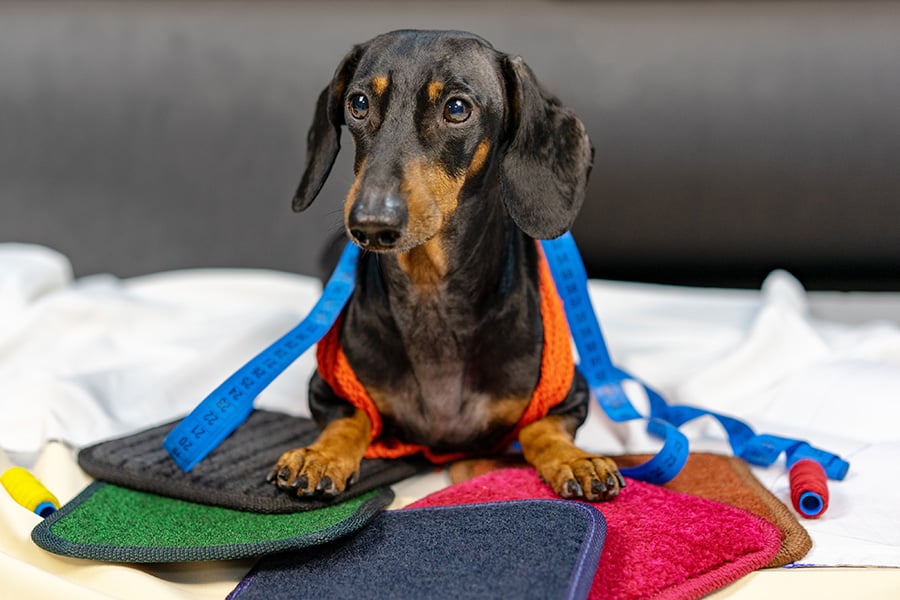
Floppy says: My legs are short, but my coat shopping list does not need to be long!
From Floppy’s owner: Choose dachshund clothing for warmth, weather protection, and comfortable movement, not simply for appearance. Measure your dog's chest, neck, and back, then check the sizing chart for the specific garment. Ordinary sweaters and coats are not medical back supports, and they have not been shown to prevent intervertebral disc disease (IVDD).
A long torso and short legs can make a coat fit well in one place and badly in another. A jacket may cover the back but hang too low underneath; a sweater may fit the neck but squeeze the chest. The goal is a garment your dog can move in normally, not the longest or tightest possible coverage.

Take three measurements
Measure back length from the point specified by the maker, often the base of the neck to the base of the tail. Measure chest circumference around the widest part and neck circumference where the garment will rest. Do not pull the tape tight enough to compress the coat.
Compare all three measurements with the chart. Small, medium, and large are not standardized across brands. “Miniature” and “standard” describe size categories, not clothing sizes, and “tweenie” is an informal description rather than a garment specification.
Check the fit while your dog moves
Put the garment on for a brief supervised trial. Let your dachshund walk, turn, sit, and lower the head to sniff. Watch for a shortened stride, a stiff posture, or repeated attempts to bite at the fabric. These can mean the design is uncomfortable or that the dog needs a gentler introduction.
- Leg openings should not rub behind the front legs.
- The lower edge should clear the ground and allow toileting without becoming wet.
- The neckline should not press on the throat.
- The back panel should not slide sideways or bunch under a harness.
- Fasteners should not catch skin or fur.
Recheck growing puppies regularly. Replace a garment that becomes restrictive rather than relying on stretchy fabric to make an undersized coat fit.
Match the garment to the conditions
For a dog that becomes uncomfortable in cold weather, consider a lightweight insulating coat with useful back and chest coverage. Smooth-coated dogs may need different protection from longhaired dogs, but age, health, wind, wetness, and the length of the outing also matter.
A raincoat can help keep the coat dry if your dog tolerates it. Reflective details may improve visibility, but they are not a replacement for keeping the dog on a leash and choosing a safe walking route. Check that a leash opening works with the harness rather than pulling the coat out of position.
In warm weather, an extra shirt or sweater is often unnecessary and can make a dog hotter. Fashion is not a reason to leave a dog in uncomfortable clothing. Remove layers when moving indoors or into a warmer environment.
Choose simple, practical construction
Look for washable fabric, smooth seams, and fasteners you can use without pulling the dog's legs into awkward positions. A back-opening design may be easier for a dog that dislikes clothing going over the head.
Avoid dangling ties, loose buttons, bells, and decorations your dog could chew off. A hood that blocks vision or slips over the face is not a good fit. Inspect garments for damage before reuse and supervise wear rather than treating an outfit as safe to leave on indefinitely.
Help a reluctant dog get comfortable
Let your dog sniff the garment, reward calm interest, and practice brief contact before dressing. Build up gradually. Freezing, moving away, or struggling is a reason to pause, not proof that the dog is being stubborn.
If clothing seems necessary but touching or dressing your dog causes pain, stop and ask your veterinarian for advice. A medical support garment should be selected for a diagnosed need, not substituted with a snug fashion coat.
The buying decision
Prioritize fit and function first, then choose the color or pattern you like. A plain coat that allows normal walking, easy toileting, and comfortable harness use is a better purchase than a stylish outfit your dog cannot tolerate.